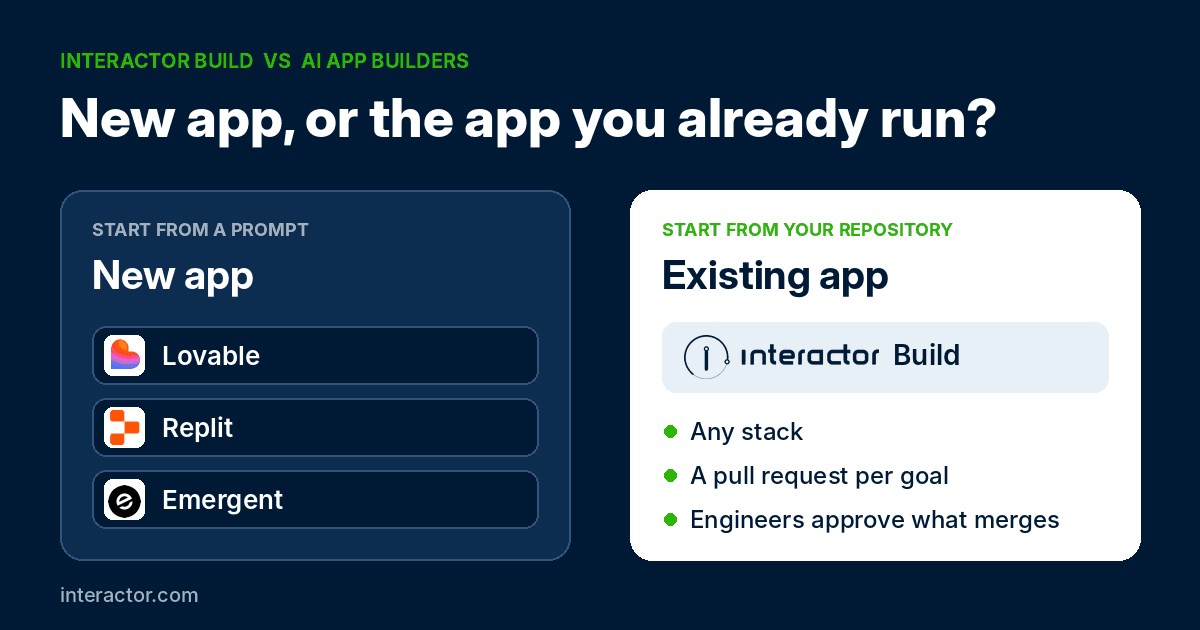
Interactor Build is an AI product-development tool for applications that already exist. Lovable, Replit and Emergent are AI app builders that start a new app from a prompt, and Lovable and Emergent generate one fixed stack. Build works in the stack your product already runs on. If you are a PM with a live product, that difference decides the choice.
Updated November 22, 2026. I am a co-founder of Interactor, so weigh what I say about our own product with that in mind. Every competitor fact below links to the vendor's own page.
Which one should you pick?
The right tool depends on whether your product exists yet. The app builders start from an empty page. Interactor Build starts from your repository.
| Your situation | Best fit |
|---|---|
| No code yet. You want a web app or prototype from a prompt | Lovable |
| No code yet. You want web and mobile from one prompt | Emergent |
| No code yet. You want to build and host in the same place | Replit |
| Live product on GitHub, in any stack, with a backlog that keeps growing | Interactor Build |
If the last row is you, you can start a goal with $10 of free credit. That covers up to ten goals on your own computers.
Can a PM use Lovable, Replit or Emergent on an existing application?
For most existing products, no. Lovable cannot take an existing repository. Emergent can pull one, but it works in its own supported stack. Replit is the exception, with an early-access workflow on its higher plans.
| Tool | Starts from | Stack it works in | Your existing application |
|---|---|---|---|
| Lovable | A prompt | React, Vite, TypeScript and Tailwind, with Supabase for the backend. Lovable's FAQ says it does not code in Python | No. Lovable's Git sync docs say "You can't import an existing repository into Lovable." |
| Emergent | A prompt | React, Next.js, FastAPI and MongoDB for web. Expo for mobile. Emergent's FAQ lists Flutter, Kotlin and Swift as not supported | Only if your app already runs on that stack. Paid plans can pull a GitHub repository |
| Replit | A prompt, or an imported repository | Any language that runs on Replit | Partly. Cloud Agents open pull requests on GitHub or GitLab for Pro and Enterprise customers. Replit's docs describe repository-based development as early access |
| Interactor Build | Your repository | Any stack. You declare your own commands | Yes. This is all it does |
Think about what a real product looks like after three years. It has a Java or Go backend, a frontend in another framework, CI rules, branch protection, and conventions nobody wrote down. A tool that generates React and Supabase has nowhere to work in that codebase. So the stack question and the existing-application question turn out to be the same question.
A PM at that company starts from a backlog. What that PM needs is a way to turn "customers need X" into a tested pull request on the product that already makes money.
How does Interactor Build support any stack?
Build does not generate a stack. It works inside yours. You add one file to your repository, pm-agent.yaml, and list your install, test, lint and build commands. Build runs those commands the same way your engineers do.
The Interactor site lists TypeScript, Python, Go, Rust, Java and Ruby. There is no migration. Your code stays in your repo, in your framework, with your conventions. Every change arrives as a pull request per goal, checked by your CI and branch protection.
Interactor Build is for founders, PMs and product owners who do not code. You state a goal in plain language. Agents investigate the current code, return a plan for your approval, then build, test and review the change. We call it "GitHub for product management."
What about Replit Cloud Agents?
Replit is the one app builder that also reaches into existing code, so it deserves a fair note. On October 27, 2026 Replit launched Cloud Agents for Pro and Enterprise customers. They let non-engineers send changes to a company codebase, in Replit's words "with engineers in control of what ships."
Replit's main product is still building and hosting new apps, and Cloud Agents sit on the $100 a month Pro plan and above. Build does one job, which is shipping goals into an existing product. It runs on your own computers at no machine charge, it prices by delivered goal, and it updates related docs, help pages and tutorials in the same release.
How does pricing compare?
The three app builders sell credits that each prompt or agent action spends. Interactor Build charges per delivered goal. List prices below are from each vendor's pricing page on November 22, 2026.
| Tool | Free | Entry paid | Next tier | What you pay for |
|---|---|---|---|---|
| Lovable | $0 | Pro, $25 a month, 100 credits | Business, $50 a month, 100 credits | Credits per prompt. Lovable's examples run from 0.50 to 1.70 credits |
| Replit | Starter | Core, $20 a month ($18 billed annually) | Pro, $100 a month ($90 billed annually) | Dollar credits spent by agent effort |
| Emergent | 10 credits a month | Standard, $20 a month, 100 credits | Pro, $200 a month, 750 credits | Credits per agent action |
| Interactor Build | $10 credit at signup | Starter, $15 a month, $20 credit | Team, $149 a month, $200 credit | $1 per delivered goal on your computers, $2 on Interactor machines |
Two things about Build's price need saying plainly. Goals that never finish are not billed. And AI usage is separate. You bring your own Claude subscription or Anthropic API key and pay Anthropic directly, so the $1 is not your full cost per goal. The app builders bundle model usage into their credits.
What can you build with the included credit?
The entry paid plans cost $15 to $25 a month, but the included credit buys different things. Lovable, Replit and Emergent credits buy prompts and agent work. Interactor Build credit buys delivered goals.
| Tool | Entry plan credit | What that credit buys |
|---|---|---|
| Lovable | Pro, 100 credits | Roughly 59 to 200 prompts, using the 1.70 and 0.50 credit examples on Lovable's pricing page. Lovable does not publish a credit count for a finished feature |
| Replit | Core, $20 of credits | Agent work priced by effort. Replit's billing docs give no price per task, and the same credits also pay for published apps, storage and databases |
| Emergent | Standard, 100 credits | Emergent's docs say a small visual tweak uses a handful of credits and a full feature with tests and publishing can use hundreds. Publishing a live app is a monthly fee from the same balance |
| Interactor Build | Starter, $20 of credit | 20 delivered goals on your computers, or 10 on Interactor machines. Each goal is a planned, tested and reviewed pull request |
The units are not the same, so read this table with care. A prompt is one step. A feature can take many prompts, and every retry spends more credit. A goal on Build is the finished change, and a goal that never finishes is not billed.
Build's number has its own gap. The $20 does not include AI usage, which you pay to Anthropic through your own Claude subscription or API key. On the app builders, model usage is inside the credit.
The free plans follow the same pattern. Lovable gives 5 build credits a day, capped at 30 a month. Emergent gives 10 credits a month. Build gives $10 once, which is 10 goals on your computers or 5 on Interactor machines.
Who checks the code before it ships?
On Interactor Build, tests, an independent review and CI run on every goal, and no setting turns them off. A check that did not run is labeled "not run." The default approval mode is Merge only, so an engineer approves what merges. Teams can choose Review everything or Autopilot.
On a prompt-to-app builder, review is mostly you looking at the preview. That works for a prototype. A live product with paying customers needs the tests and the engineer.
We run Build on Build. As of November 12, 2026, Build's own product had 4,036 merged goal PRs, 9 incident post-mortems and 98 runbooks. Eating our own dogfood is how we found most of the rules above.
Where is Interactor Build the wrong choice?
Build is the wrong choice when you have no repository and want a clickable app today. Lovable, Emergent and Replit are faster for that.
Build is slower on purpose. It investigates, plans, tests and reviews before a pull request appears. If nobody on your team can read a pull request, the engineer approval step has no owner, and an app builder with hosting included will suit you better.
Build also does not host your app. It works inside the repository, CI and deployment you already have.
How do you try Interactor Build on a real backlog?
Pick five real goals from your backlog and run them. Connecting a repository writes nothing to it, and the first $10 of credit is free.
Start a goal on Interactor Build or read the pricing details first.
So PMs: how long does one backlog item take at your company today, from request to merge?
Frequently asked questions
Is Interactor Build the only way for a PM to work on an existing application?
Of these four tools, Build is the only one made only for existing applications in any stack. Replit offers Cloud Agents on Pro and Enterprise. Coding agents such as Claude Code also work on existing code, but they are made for engineers at a terminal.
Can I move a Lovable prototype to Interactor Build?
Lovable syncs a project to a GitHub repository, and Build connects to GitHub repositories, with TypeScript among the stacks it lists. You would add a pm-agent.yaml with your commands and connect the repo. We have not published a step-by-step guide for this yet.
Do I need engineers to use Interactor Build?
A product owner can write and approve goals without coding. Build is designed for a team where an engineer sets the rules and approves merges, so you get the most from it with at least one engineer.
Do unfinished goals cost anything on Interactor Build?
No. Build bills a goal when it is delivered. A goal that never finishes is not billed. Your own Claude or Anthropic usage during that goal is still charged by Anthropic.