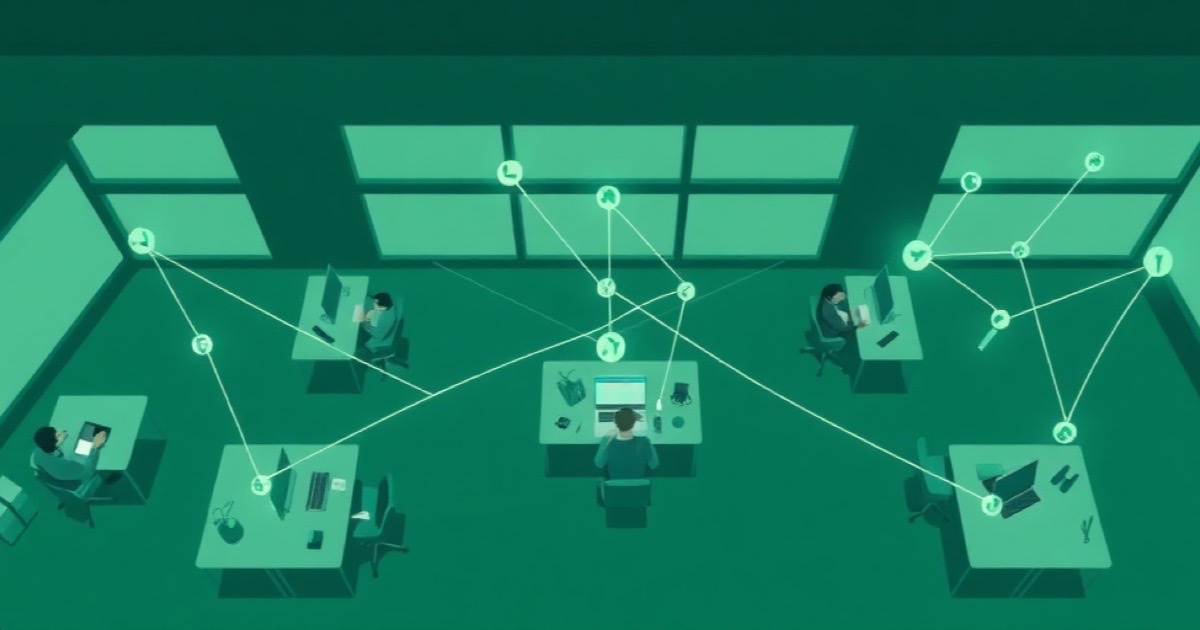
Short answer: AI that answers your questions and AI that executes your processes are different things. The second is a workforce, and managing it gets spread across the people you already have: each person sets direction, defines goals and approves work. That quietly promotes everyone to manager, and makes them accountable for decisions they never watched.
"What would you do with a hundred more engineers?"
At Interactor, that's a question we often ask customers to help them understand what AI means for them. And they generally have a clear answer.
We tend to think of new innovations in terms of new capabilities. But how the new capability translates into the business often determines whether an organization succeeds with it.
With AI, what it translates into is capacity. With the right implementation, your workforce can scale on demand: a workforce that is highly knowledgeable, highly skilled and highly scalable.
What do the answers reveal?
The answers to the hundred-engineers question tell you what has been failing. They describe work that has been waiting on capacity, not on technology.
A founder we spoke with answered without pausing. He would finally build the thing he had already failed to build three times.
A marketing team answers differently. Ask them and you'll hear about the campaigns they cut and the locales they never launched. The tests they never ran. The agency work they've been coordinating by hand for years.
Neither answer mentions a model or a tool. Both describe work that has been waiting on a workforce that never arrived.
What's the difference between AI that answers and AI that executes?
AI that answers responds to a prompt and leaves the decision with you. AI that executes runs a process on its own, inside goals and boundaries you set. The familiar picture of AI is the first kind, which is what makes the second hard to see.
The familiar kind responds. You prompt it, it answers, and you decide what to do with the answer. It's genuinely useful, and it's most of what people have actually touched.
The other kind executes. Executing AI is AI that runs a business process, such as your ad spend, your production scheduling or parts of how your software gets built. You set the goal and the boundaries, and it works inside them without coming back to you each time.
Both are real, and prompts still matter a great deal for the second kind. But they aren't the same thing, and the difference is most of the point here. Notice that nobody answers the hundred-engineers question by saying they'd have more conversations. They answer with work that gets done.
You don't manage a tool that answers questions. You manage a workforce that executes. That's what turns AI adoption into a management problem rather than a software purchase.
Does everyone get their own AI team?
Usually not. The company gains an AI workforce, and managing it gets distributed across the people already there, often shared, with several people directing the same work.
So what does a person actually own? Three things, and they're worth naming precisely:
- The direction they set.
- The goals they defined.
- The approvals they gave.
That's a short list. It will also increasingly become the whole list.
Why does AI make everyone a manager?
Setting direction, defining goals and approving work is management. It has always been management. We just used to reserve it for the people with the title. Many good management skills will translate, albeit in a different context.
Now that management is spread across the team, nobody has told them. Their title didn't change, their training didn't change, and the org chart still lists them as individual contributors.
You've distributed management across your entire staff, and you probably haven't mentioned it to anyone. Including yourself.
The good news is that this isn't a new discipline. It's what tech leads and program managers have always done. You're just applying it far more widely now.
Which parts of your org structure no longer make sense?
The ones built around a limit that AI removes. Those structures don't disappear on their own; they stay, staffed and budgeted, managing access to capacity you now hold in-house.
The marketing team shows this clearly. They had people whose job was coordinating outside agencies, because the work was manual and agencies were how you bought capacity.
That's a structure built around a limit.
Remove the limit and the structure has no reason to exist. But it doesn't go away on its own.
This is usually where the change actually bites. It's slower and more political than anything technical in the project.
Which roles you keep comes down to one question. Are you trying to do the same work with less, or more work with the same?
Who is accountable when AI does the work?
Work delegates. Increasingly, decisions delegate too. Accountability doesn't.
There's nowhere for it to go. When something goes wrong, nobody calls the algorithm. They call your company, and your company needs a person who can explain it and fix it.
That person is whoever set the direction, defined the goal, or gave the approval. Which is the same rule we've always used for human teams. A manager answers for the work they directed, not for the keystrokes they made.
So those three things on the short list are exactly the three things your people are now answerable for.
This gets considerably harder once the AI is executing rather than answering. When you prompt and read the reply, you at least saw it. When it's running a process, most of what it does you never see. Your people end up answerable for decisions they didn't watch.
But this is no different from answering for work done by a team member. And a well-designed system very likely leaves more traces of each decision than most people would.
How far can AI scale your output?
Only as far as your people can stand behind what comes out. Output goes up, and that part is real; it's why the capacity is worth buying. But the ceiling isn't the tooling.
Past that line you're not adding capacity. You're adding exposure. Output that nobody can defend, in a company that will still be asked to defend it.
Same work with less, or more work with the same. That choice lands here: cutting the people who can stand behind the output lowers the ceiling you were trying to raise.
So the planning question generally isn't just the AI. For every place you're scaling output, ask who can stand behind it, and whether they would still be able to tell if it were wrong.
How well the AI is implemented to support this, and how well the team is trained to be accountable, determines how far an organization can scale with it.