Your Agentic AI, Enterprise-Grade at Scale
Technical Brief · For teams already building with LangGraph / Custom Frameworks
How your existing investment in LangGraph or any custom agentic framework expands to production-scale actions, multi-agent coordination, and enterprise system integration with Interactor's infrastructure layer.
You've Already Built the Hard Part
Teams building with LangGraph or custom frameworks have made significant investments that most organizations are still years away from achieving. Interactor is the infrastructure layer your stack grows into as you scale.
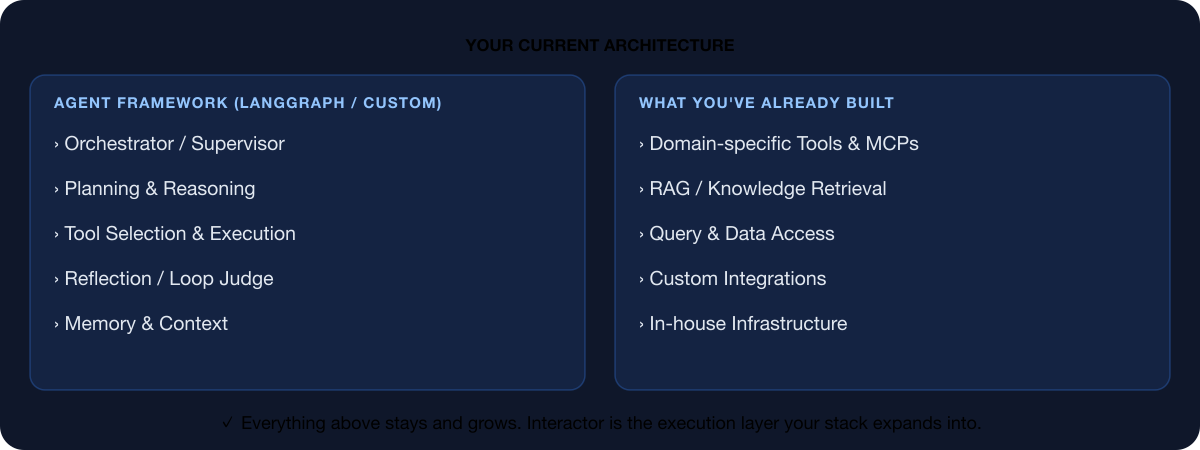
The Next Layer: Your framework excels at reasoning and querying. The next phase — taking real actions on enterprise systems, coordinating multiple specialized agents, and running structured approval workflows — requires a dedicated infrastructure layer.
The Scale Challenges Ahead
As you move from querying to acting — and from one agent to many — challenges emerge that require a different layer of infrastructure.
| Challenge | Current Scope (Agent, Query) | Next Phase (Multi-Agent, Action) |
|---|---|---|
| Agent Coordination | One agent graph with internal nodes | Specialized agents (domain, ops, data, notification) must discover each other, share context, and coordinate without loops or authorization leakage |
| Enterprise System Access | Read-only queries with static API keys | Write actions on ERP, ITSM, CRM, and internal systems — each requiring the right credential, the right scope, with token refresh and a full audit log |
| Credential Management | API keys in config or env vars | Many users, many systems, different access levels — who can authorize which AI action on which system, and under what conditions? |
| Process Workflows | Ad-hoc tool execution, no approval | Request → AI analysis → human approval → system update → audit record — all structured, repeatable, and traceable |
| Compliance & Audit | LangSmith traces (debug only) | Enterprise governance requires: who instructed what action, what AI reasoning was applied, what human approved it — a full, immutable chain |
The Four Multis
Interactor is the enterprise infrastructure layer for Agentic AI, designed around four dimensions that every production deployment must solve.
1. Multi-Tenant 🏢
Enterprise-grade credential isolation and access control across teams, roles, and systems.
- Encrypted credential storage per user
- Sharing scopes: personal / channel / workspace
- Per-tenant usage limits and billing
- OAuth flows with automatic token refresh
2. Multi-Agent 🤖
Infrastructure for agents to discover, delegate to, and collaborate with each other safely at scale.
- Agent service registry via Knowledge Base
- Delegation with context preservation
- Cross-agent authorization model
- Built-in loop detection and circuit breakers
3. Multi-Service 🔌
Connect and take actions on any system — legacy or modern — with a unified integration layer.
- Capability specs for any HTTP API
- OAuth, API Key, Basic Auth, Bearer Token
- Read and Write actions with credential enforcement
- Full audit trail on every executed action
4. Multi-Process ⚙️
Orchestrate multi-step workflows that span systems, agents, and human approvals.
- Semantic workflow pattern matching
- Human-in-the-loop approval gates
- Parallel and sequential execution plans
- Persistent process state across turns
How Your Stack and Interactor Fit Together
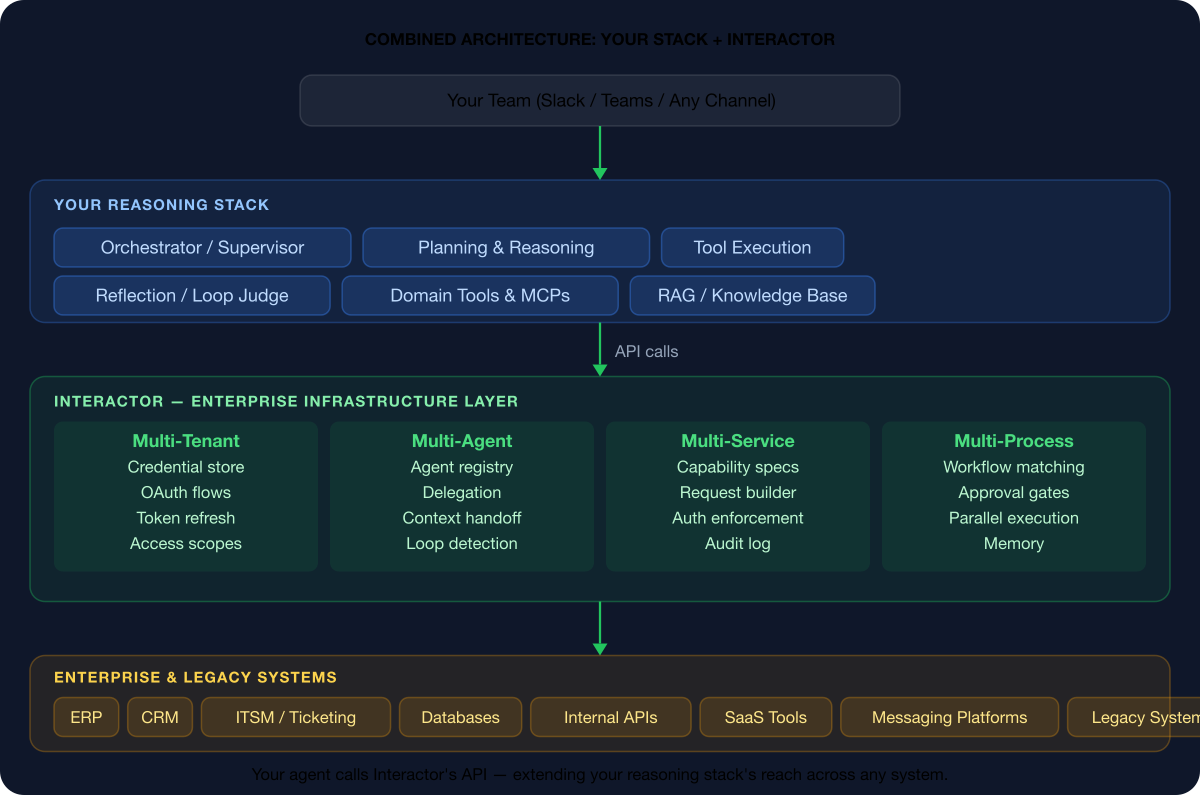
Interactor operates as the execution infrastructure layer. Your agent framework remains the reasoning engine — it calls Interactor when it needs to act, integrate, or orchestrate.
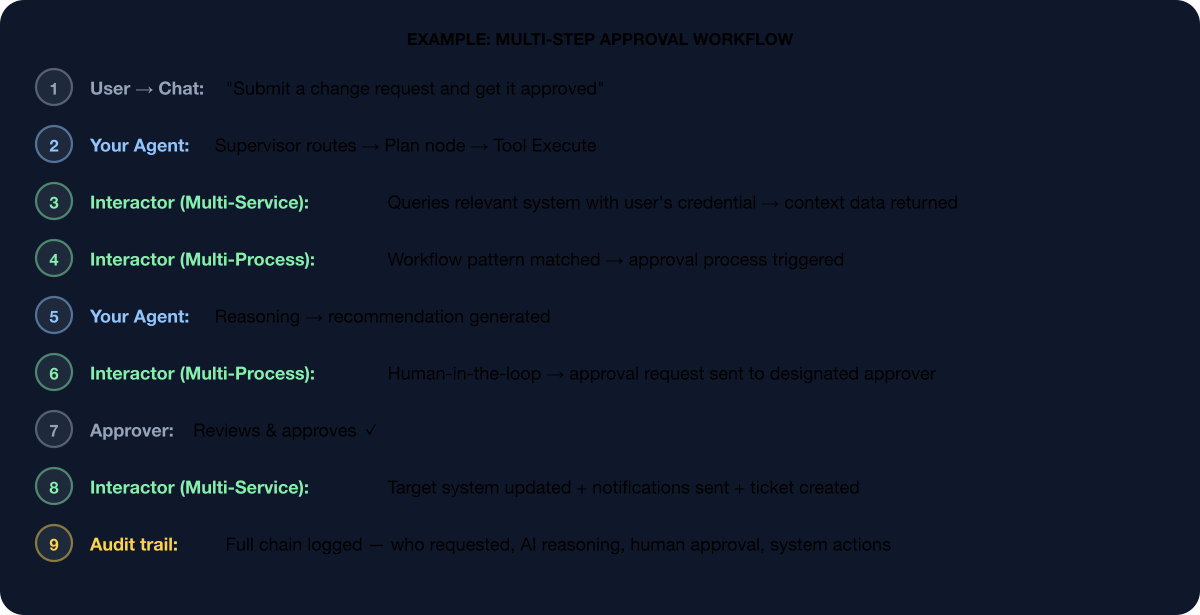
Example: Multi-Step Approval Workflow
Why Not Build This Yourselves?
Your team has proven it can build sophisticated infrastructure. The question isn't capability — it's where your engineering attention creates the most value.
🔒 Security You Can't See Credential management for enterprise systems requires security architecture, not just functionality. Subtle token isolation bugs or encryption mistakes are invisible until there's a breach — and one incident in a production environment can be catastrophic.
🐛 Production Edge Cases Take Years OAuth token expiry mid-conversation, API rate limits, malformed payloads — these aren't in any spec. Interactor has hit them in production and fixed them. Building from scratch gives you the 80% that works in demos.
🔄 Distributed Systems Are Hard Multi-agent coordination, cross-agent authorization, loop detection, and context handoff are distributed systems problems. They fail under concurrency in ways that are hard to reproduce and harder to debug.
🎯 Your IP Is Elsewhere Your competitive advantage is your domain AI — the specialized tools, domain knowledge, and the agent behaviors that make your product unique. Every sprint on credential infrastructure is a sprint not spent on your next domain capability.
The Principle: Build what makes you a domain AI company. Use what makes you an infrastructure company. Interactor is infrastructure — so you don't have to be.
How We Engage
[Phase 1: Assessment] ──── [Phase 2: Integration] ──── [Phase 3: Scale Up]
Phase 1 — Assessment
- Understand current architecture & goals
- Map systems, workflows, and pain points
- Identify highest-value integration targets
- Define credential and access requirements
- Deliver a concrete integration roadmap
Phase 2 — Integration
- Deploy Interactor alongside your stack
- Register Capability Specs per assessment
- Configure credential policies and OAuth flows
- Enable write actions with full audit trail
- Connect approval workflows to your processes
Phase 3 — Scale Up
- Multi-Tenant: hardened credential isolation at scale
- Multi-Agent: specialized agents with delegation
- Multi-Service: expanded system integrations
- Multi-Process: structured workflows & approvals
How It Works: Phase 1 is a collaborative assessment — no deployment, no commitment. The integration roadmap it produces determines exactly what Phase 2 looks like for your stack. Each phase builds on the last.
Summary
"Your agent stack makes great decisions. Interactor makes sure those decisions are executed safely, at scale, across every system — with a full audit trail."
| Pillar | Your Current State | With Interactor | Timeline |
|---|---|---|---|
| Multi-Tenant | Custom-built or partially addressed | Production-hardened at scale, OAuth managed | Phase 3 |
| Multi-Agent | Single agent with nodes | Specialized agents with delegation infrastructure | Phase 3 |
| Multi-Service | Query-only tools | Write actions on any system, auditable | Phase 2 |
| Multi-Process | Ad-hoc tool execution | Structured workflows with human approval gates | Phase 2 |
Interactor · Enterprise Agentic AI Infrastructure
For teams building with LangGraph or custom agentic frameworks